Also see my Founder page.
Look up a therapist and you’ll see a row of letters after their name: LCSW, LPC, LMFT, PsyD, PhD. It’s natural to wonder whether one set of letters means a better therapist than another. It’s a fair question, and the answer is more useful than most people expect.
Here’s the short version: the credential tells you about training and what the clinician is legally allowed to do. It tells you much less about how good they are at the work. Experience, continuing education, specialized certification, and reputation among clients and colleagues usually predict the quality of care better than the letters do.
That doesn’t mean credentials don’t matter at all. They do, in specific ways. Let’s go through them.
If you’re trying to figure out whether a clinician’s background fits what you need, I offer a free 30-minute video consultation where we can talk through your situation. Contact me here.
What a Credential Actually Tells You
Every licensed mental health professional has completed a graduate degree, supervised clinical hours after the degree, and passed a licensing exam. The specifics vary by state and by profession, and the number of supervised hours typically runs into the thousands.
Two things follow from that. First, the credential is a floor. It means the person met the state’s minimum standard to practice. Second, the credential defines scope: what the clinician can diagnose, which tests they can administer, and whether they can prescribe medication. Those differences are real.
The Main Credentials
LCSW (Licensed Clinical Social Worker). Holds a master’s in social work (MSW) and has completed supervised clinical hours. LCSWs are trained in therapy, diagnosis, and the social and environmental context of a person’s life: family systems, work, housing, money, and community. They can diagnose and treat in private practice in every state where they’re licensed. They cannot prescribe medication.
LPC or LMHC (Licensed Professional Counselor or Licensed Mental Health Counselor). Holds a master’s in counseling and has completed supervised clinical hours. Training is centered on counseling and therapy. Like LCSWs, they diagnose and treat, but they don’t prescribe. The title varies by state.
LMFT (Licensed Marriage and Family Therapist). Holds a master’s in marriage and family therapy. Training is focused on relationships and systems, so the lens is on how people and their relationships interact. LMFTs can treat individuals, couples, and families. They can diagnose and treat, but they can’t prescribe.
PsyD (Doctor of Psychology). A doctoral degree, usually four to five years of graduate work and a clinical internship. Training emphasizes clinical practice over research. Psychologists can diagnose, treat, and in most states administer psychological testing, which is useful for evaluating learning disorders, ADHD, or complex diagnostic questions. Most psychologists don’t prescribe. A small number of states allow specially trained psychologists to prescribe.
PhD (Doctor of Philosophy, in clinical or counseling psychology). A doctoral degree with a stronger research component, usually including a dissertation. Clinical PhDs are trained to diagnose, treat, and conduct testing, and many also do research. Like PsyDs, they typically don’t prescribe.
MD (Doctor of Medicine), psychiatrist. A physician who completed medical school and a residency in psychiatry. Psychiatrists can prescribe medication, and some practice only medication management, meeting briefly for check-ins. Others provide both medication management and psychotherapy. If you’re considering medication, a psychiatrist is the clinician with the most training in that area. A future post will go deeper on the different types of prescribers, so I’ll leave that for another day.
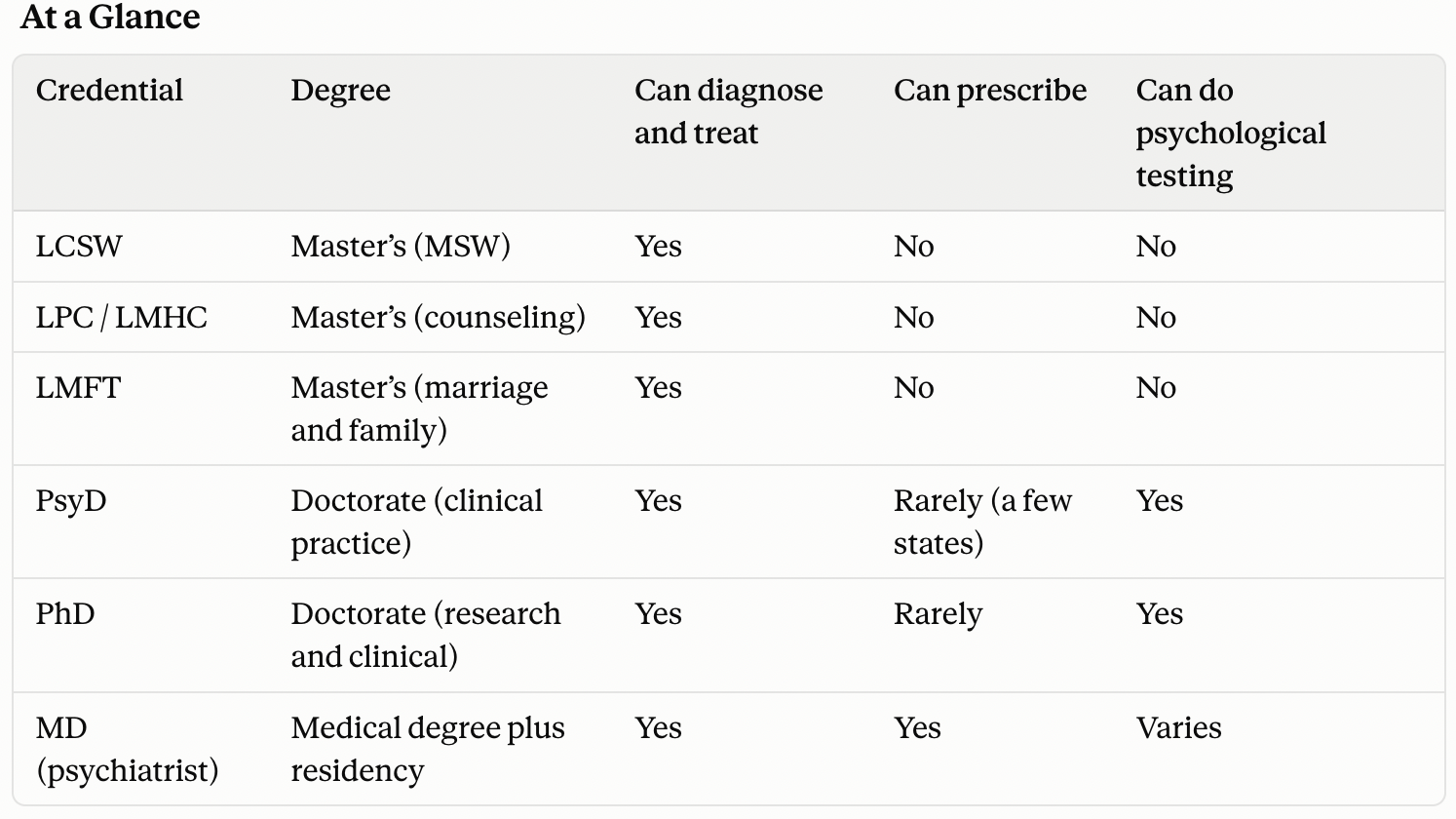
Keep in mind that scope rules vary by state, and some clinicians hold more than one license.
-Matt Sosnowsky, founder of Philadelphia Talk Therapy
What Actually Predicts a Good Therapist
Once you know what a credential means, the more useful question is whether the clinician is good at the work. That comes down to four things.
Experience. How many years have they been practicing? How many clients have they worked with on your concern? A clinician who has spent a decade treating anxiety has seen far more of it than someone who is two years out of school, regardless of which letters they hold.
Continuing education and certification. The field keeps changing, and the best clinicians keep learning. Look for training in approaches that are relevant to your concern, such as EMDR for trauma, ERP for OCD, or Emotionally Focused Therapy for couples. Certifications and advanced training signal that someone has gone deeper into a specific area.
Reputation. Good clinicians are known by the people who refer to them. Pay attention to who sends clients to them: physicians, other therapists, coaches, and former clients. Testimonials and reviews help too, with one caveat. Reviews are an imperfect signal, since they can be curated, sparse, or written by people with unusual expectations. Look for patterns across many reviews rather than a single glowing or angry one.
Fit. Credentials and reputation can’t tell you whether you’ll work well together. That’s what the consultation and intake are for. You’ll learn more in one conversation than in a year of reading profiles.
So Does the Degree Matter?
Yes, but mostly in narrow ways. The degree shapes scope: whether someone can prescribe, whether they can administer testing, and what kinds of clinical questions they’re trained to answer. If you need a medication evaluation or a formal psychological assessment, the credential matters a great deal.
For most day-to-day therapy, such as working through anxiety, depression, a relationship pattern, or a difficult career stretch, the difference between an LCSW, LPC, LMFT, and PhD is much smaller than the difference between a clinician with five years of experience and one with twenty, or between someone who has trained extensively in the approach you need and someone who hasn’t.
When you’re choosing, look at the whole picture: the credential as a baseline, then experience, training, reputation, and how the clinician makes you feel in the first conversation.
How This Applies to My Practice
I’m an LCSW with a master’s in social work and a master’s in positive psychology from Penn. Those credentials are my baseline. I’ve been a psychotherapist for fifteen years, working mostly with high-functioning adults in their 20s, 30s, and 40s, with a focus on anxiety, depression, OCD, men’s mental health, and life transitions. My practice grows through referrals from clients and from physicians, therapists, and coaches who have seen the work, and my work has been featured in The New York Times, Self, VeryWell Mind, Vox, Forbes, Oprah Daily, and HuffPost.
If you want to know more about my background and how I work, contact me for a free 30-minute video consultation. It’s the best way to tell whether we’re a good fit, and you’ll hear back within 24 hours.
About the Author:
Matt Sosnowsky, LCSW, MAPP, is a therapist in Philadelphia specializing in relationship patterns, communication, attachment, and therapy for men. He works with high-functioning professionals navigating the complexities of intimate relationships. He uses evidence-based approaches including emotion-focused therapy, attachment work, and communication skills training. He has been featured in The New York Times, Oprah Daily, Self Magazine, VeryWell Mind, and HuffPost. His practice serves young and middle-aged adults in Center City Philadelphia and virtually across PA, NJ, DC, MD, VA, and WA.
Related Reading: