Therapy Options Compared: Insurance, Out-of-Network & Online Platforms, and What Each Is Good For
Also see Insurance Explainer.
“Find a therapist” sounds like one market. It isn’t. There are at least six distinct ways to get therapy, and they differ in cost, how clinicians are selected, how much time you get, and what kind of care you’re likely to receive. Most people choose without knowing the options, usually by whatever shows up first.
This post lays out the main categories honestly, including where each one works well and where it falls short. My own practice is in one of these categories, and I’ll say so clearly, but the goal here is for you to choose with accurate information, not to be sold to.
If you already know you want to look at out-of-network options, I offer a free 30-minute video consultation to talk through what fits your situation and what working together would cost. Contact me here.
1. In-Network Therapists (Insurance Panels)
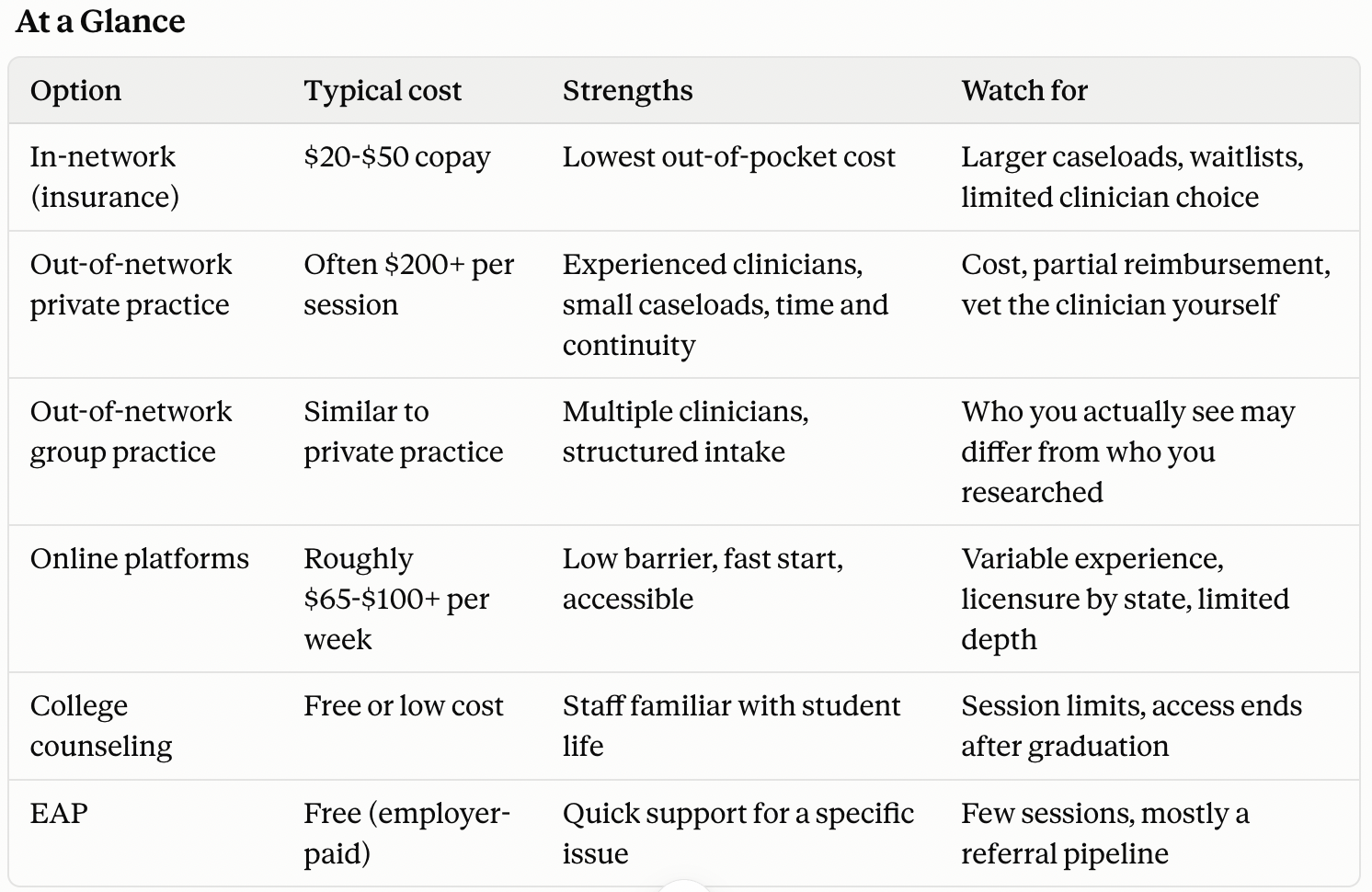
These clinicians accept your insurance directly. You pay a copay, often in the range of $20 to $50, and the insurer pays the clinician a negotiated rate.
The upside: Lowest out-of-pocket cost. Easiest financial path for most people.
The trade-offs: Insurers’ reimbursement rates are often low relative to what clinicians spend to run a practice. Many skilled therapists have left insurance panels for that reason, which means the in-network pool is a smaller slice of the field than most people assume. Clinicians who stay on panels often carry larger caseloads to make the numbers work. Finding an in-network therapist with openings can also take weeks, and directories are often out of date.
Who it’s best for: People whose insurance covers what they need, who are comfortable with a longer search, and who can afford a higher caseload-to-attention ratio.
2. Out-of-Network Private Practice
Here, the therapist runs an independent practice and sets their own fee. You pay the session fee directly. Many clients submit a superbill to their insurer afterward, and some plans reimburse part of it. Coverage depends entirely on your plan, so check your out-of-network benefits before you commit.
Fees for experienced out-of-network clinicians often start at $200 per session and go higher. For the specific rate at my practice, contact me for a free consultation. The rate is not listed here.
The upside: Clinicians here are not paid by insurance panel rates, so they set their own caseloads and session structure. This model tends to attract experienced clinicians who have built their practice around the work they want to do. Clients get more time, more continuity, and more say in who they work with. Many people in this category also have a long-standing, deliberate approach to their work rather than a fixed template.
The trade-offs: Cost is real and not every client can afford it. Insurance reimbursement is partial at best and varies by plan. Not every out-of-network therapist is excellent, and the price alone doesn’t tell you the quality. You have to do the vetting yourself.
Who it’s best for: People who can pay out of pocket or whose plan reimburses well, who want a specific clinician with a specific approach, and who value privacy, continuity, and time.
“Speaking plainly, many of the most experienced and highly skilled clinicians I know operate out-of-network private practices.”
-Matt Sosnowsky, founder of Philadelphia Talk Therapy
3. Out-of-Network Group Practices
These are multi-clinician practices, both local and national, that operate outside insurance panels. Some are well run and staffed by strong clinicians. Others function more like a clinic: high turnover, many clinicians you may never meet, and quality that varies widely.
The upside: Multiple clinicians, sometimes more availability, and often a structured intake process. Some are very good at matching clients to clinicians.
The trade-offs: The clinician you’re matched with may not be the person whose name you saw in the marketing. Ask who will actually provide your care, how long they’ve been practicing, and how often they switch clinicians. Pricing is typically similar to solo out-of-network practice, so you’re paying a premium for infrastructure rather than individual attention.
Who it’s best for: People who want a practice with multiple specialists under one roof, who understand that the clinician may vary, and who ask direct questions before committing.
4. Online Therapy Platforms
Services like BetterHelp and Talkspace offer text, video, and phone therapy for a weekly subscription, often in the range of $65 to $100 or more per week. Plans commonly include messaging between sessions, and some are partially covered by certain insurance plans.
The upside: Low barrier to entry. Fast to start. Easy to access from anywhere. For someone who has never been to therapy or who can’t get to an office, a platform can be a real first step.
The trade-offs: Clinicians on these platforms vary significantly in experience, and many are early in their careers. Licensure must match your state, so confirm that before you start. Platforms are generally not designed for complex presentations, diagnosis, or long-term work on deeper patterns. Messaging is convenient but usually thinner than sustained session work. Subscriptions can be hard to pause or cancel, so read the terms.
Who it’s best for: People with a relatively focused concern, who want low-cost, low-commitment support, and who understand that depth and continuity are limited.
5. College Counseling Centers
Most colleges and universities offer counseling to enrolled students at little or no cost. Services are usually short-term, with a limited number of sessions per semester, and staff are trained to handle crises and triage.
The upside: Free or very low cost. Staff understand student life and campus stressors.
The trade-offs: Session limits. Long waitlists during peak periods. Once a student leaves school, access ends. For ongoing or complex work, a referral to an outside clinician is often the next step.
Who it’s best for: Current students with short-term needs, or anyone who needs immediate support while they figure out next steps.
Where Private Practice Fits, and Who It’s For
I practice out of network, so I’ll be direct about what that model offers and what it asks of you.
Out-of-network private practice is a boutique service. Clinicians in this model generally have more control over their caseload, their schedule, and how they work with each client. That allows for more time in sessions, more continuity over the course of treatment, and a level of attention that is hard to sustain on a high-volume insurance panel.
I’d also say plainly that many of the most experienced and highly skilled clinicians I know practice this way, or own practices like this. Good therapy depends on more than credentials and caseload size. It depends on skill, judgment, warmth, and the ability to stay with difficult material over time. Clinicians who have developed those capacities over many years tend to be in a position to choose how they work, and many choose private practice for exactly that reason. The same is true of skilled clinicians who work in network, and the best choice for you depends on your situation.
This model is a fit for people who have the resources to invest in their care, who want a specific clinician with a specific approach, and who value privacy, continuity, and attention. It is not the right fit for everyone, and it isn’t the only good option.
Final Thoughts
If you’re weighing private practice against insurance, a good first step is a consultation. Ask about fees, session length, cancellation policy, superbill process, and how the clinician works. You’re entitled to know exactly what you’re paying for before you commit.
To learn about current rates at my practice, contact me for a free 30-minute video consultation. We’ll talk through what you’re dealing with, who I work with, and whether private practice makes sense for you. You’ll hear back within 24 hours.
About the Author:
Matt Sosnowsky, LCSW, MAPP, is a therapist in Philadelphia specializing in relationship patterns, communication, attachment, and therapy for men. He works with high-functioning professionals navigating the complexities of intimate relationships. He uses evidence-based approaches including emotion-focused therapy, attachment work, and communication skills training. He has been featured in The New York Times, Oprah Daily, Self Magazine, VeryWell Mind, and HuffPost. His practice serves young and middle-aged adults in Center City Philadelphia and virtually across PA, NJ, DC, MD, VA, and WA.
Related Reading: