

Why most experienced therapists don't take insurance
A straightforward guide to understanding how therapy and insurance really work
When you start looking for a therapist in Philadelphia, you'll quickly notice a split: a short list who take your insurance, and a much longer list who don't. It's natural to assume the in-network ones are the practical choice. In most of healthcare, that's true. In therapy, it's more complicated.
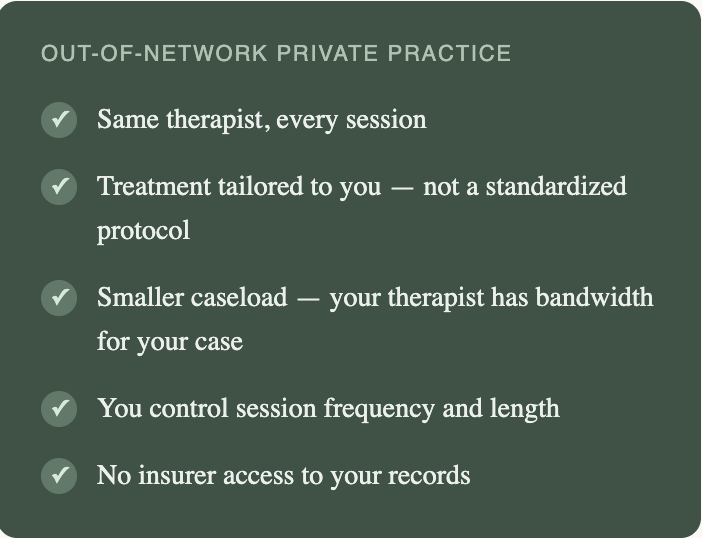
Most experienced therapists start their careers accepting insurance. Many eventually stop — not to be exclusive, but because the economics make it hard to do good work.
Insurance reimbursement rates are low. To stay financially viable, an in-network therapist typically needs to carry 25–35+ clients per week. At that volume:
There's less time to think carefully about each person
Treatment becomes more standardized, less tailored
Burnout is common — and turnover is high
Insurers can limit sessions and audit treatment records
The therapists who go out-of-network do so because they'd rather work with fewer clients and do it well. That's the structural reality of how the system works; but your insurance may still help.
Read a Propublica Article explaining the problems with In-Network Care.
What about BetterHelp or Talkspace?
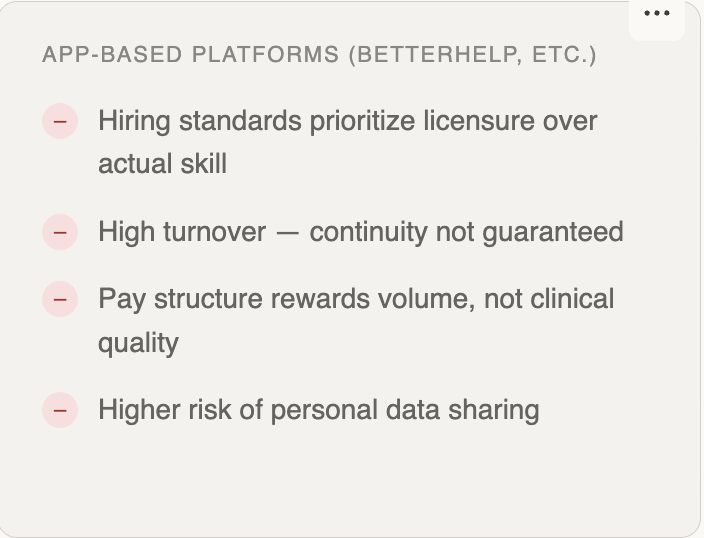
These platforms are easier to access and cheaper upfront. But the central issue is straightforward: you're unlikely to be matched with a seasoned, specialized clinician. Therapists on these platforms are often early-career, paid at low per-session or per-message rates, and face the same high-volume pressures as in-network providers — sometimes worse.
The good news: your insurance may still help
Many plans — especially PPOs and employer-sponsored plans — include out-of-network mental health benefits.
Here's how the process works in 3 simple steps.
-
![Payment for therapy in Philadelphia]()
1. Pay your therapist
We keep a card on file and process your payment automatically after each session.
-
![Uploading payment for Philly therapy]()
2. Submit your superbill
We send you an itemized receipt (a.k.a. superbill) with everything your insurer needs. You upload it directly to your insurance company's portal.
-
![Reimbursement for Philadelphia counseling services]()
3. Get reimbursed
Your insurer processes the claim and sends reimbursement directly to you—often by check or direct deposit.



If you’d like to know exactly what you’ll be reimbursed, below is a brief primer on how to contact your insurance company and what to ask.
Questions to ask your insurance company
Call the member services number on the back of your card. Ask for a reference number at the start of the call.
Do I have out-of-network benefits for outpatient mental health services?
What is your allowable rate for a standard outpatient psychotherapy session (CPT code: 90834)?
What is my out-of-network deductible, and how much has been met?
Once my deductible is met, what percentage do you reimburse for out-of-network outpatient psychotherapy?