

Therapist in Maryland
I'm a licensed therapist offering virtual sessions to clients throughout Maryland.
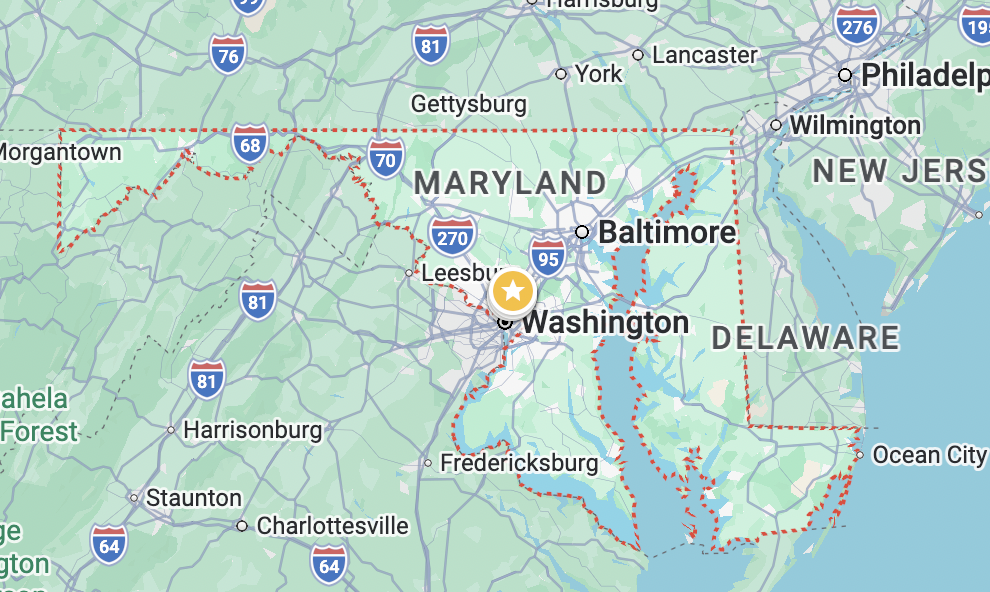
Much of my practice centers on high-functioning adults in the suburban-Maryland orbit — people in Montgomery County and the surrounding areas, in Bethesda, Silver Spring, Rockville, and Chevy Chase, working in federal science and health, medicine, law, academia, and consulting. Accomplished, conscientious people who are handling a great deal capably and are nonetheless stuck on something they can't resolve alone.
I know this region
I practiced for years in Washington, D.C. — from 2013 to 2020 — at the center of the DMV. My clients were never only from the District. Suburban Maryland is part of the same integrated region, and I regularly worked with people who lived in Bethesda or Silver Spring and commuted into the city, or who worked in federal and health institutions clustered along the Maryland side. I know that world: the NIH-and-federal-science professional, the physician, the academic, the person whose competence has never been in question and whose inner life rarely gets asked about.
Maryland's professional culture carries a slightly different weight than D.C.'s core — a bit more settled, more family-anchored, more likely to be balancing a demanding career against a household and a commute. But it's shaped by the same gravitational field: high standards, high stakes, and a quiet expectation that you have it handled. I understand that environment from years of working at its center, and I still see Maryland clients today.
You won't have to explain the world you operate in. I already know it.
What brings Maryland clients to therapy
The pressures I see most often across suburban Maryland:
A career that quietly became the whole identity. When your work is your standing and your self-worth, stepping back to question it can feel like pulling a thread you're afraid to pull.
Achievement that stopped delivering. The tenure, the attending role, the senior appointment. You reached it, and the satisfaction you expected didn't fully arrive.
Relationships strained by the load. Two careers, kids, a commute, and a calendar that leaves little room for the relationship underneath it all.
Anxiety running underneath. Frequently long-standing and unnamed — sleeplessness, over-preparation, a vigilance that never fully switches off.
Transition. Grants end, roles shift, children leave, parents age. Even the expected transitions land harder than people admit.
“Outstanding therapist. Matt’s approach to psychotherapy combines a rare breadth of scientific knowledge with a deep understanding of what it fundamentally means to be a thriving human.”
— Former Colleague
How I work
I take an eclectic, evidence-based approach — matching the method to the person rather than running everyone through the same protocol. Depending on what you're working on, that may include:
Cognitive Behavioral Therapy (CBT) for anxiety, rumination, and unhelpful thought patterns
Acceptance and Commitment Therapy (ACT) for values clarification and psychological flexibility
Internal Family Systems (IFS) for internal conflict and self-criticism
Emotion-Focused Therapy (EFT) for accessing what's underneath
Psychodynamic work for long-standing relational patterns
Exposure and Response Prevention (ERP) for OCD
Positive psychology for meaning, purpose, and strengths — I hold a master's in this specifically
I'm known for being direct. Clients tell me they appreciate that I'll say what I actually think rather than nodding.
What I help with
Anxiety & Stress— practical tools to quiet the noise and feel more in control
Depression & Burnout — support for low mood, fatigue, and finding your way back
Career & Identity— clarity when work feels stuck or unfulfilling
Life Transitions — steadier footing through change
Relationships — individual work on patterns that keep repeating
Men's Therapy — stress, self-doubt, and the pressure to hold it together
OCD Treatment — evidence-based care for intrusive thoughts
Sessions
All Maryland sessions are virtual, conducted over VSee, a HIPAA-compliant secure video platform. You'll need a private space and a reliable connection.
A 60-minute intake to start, then 50-minute sessions weekly or biweekly. Daytime and evening hours available, with evenings limited.
For virtual sessions, you need to be physically located in Maryland — or another jurisdiction where I'm licensed — at the time of the session.
Credentials and licensure
I'm Matt Sosnowsky, LCSW, MAPP. I hold two graduate degrees from the University of Pennsylvania — a Master of Social Work and a Master of Applied Positive Psychology — and have over 15 years of clinical experience across agency, private practice, and digital health settings.
Maryland license #18136. Pennsylvania license #CW021603.
My work has been featured in The New York Times, Vox, SELF, VeryWell Mind, HuffPost, Oprah Daily, and Condé Nast Traveler. See media coverage.
FREQUENTLY ASKED QUESTIONS
-
No — my office is in Philadelphia, and I see Maryland clients virtually. But Maryland isn't unfamiliar to me. I practiced in Washington, D.C. for years and regularly worked with clients from across suburban Maryland. I know the region and the particular pressures of the professional life there.
-
I'm an out-of-network provider. I don't bill insurance directly, but many clients receive partial reimbursement through out-of-network benefits, and I provide a monthly superbill for submission. My out-of-network explainer covers how to check your benefits before you commit.
-
For a virtual session you need to be physically located in Maryland (or another state where I'm licensed) at the time of the session.
-
I'm also licensed in Pennsylvania, New Jersey, Washington, D.C., Virginia, and Washington State. If you'll be somewhere else, we'll plan around it.
-
Email, call, text or message us. From there, we'll schedule a free 30-minute video consultation. The consult is conversational — you'll have a chance to share what's going on, ask questions, and get a feel for how I work. If it seems like a good fit, we'll schedule your first full session from there.
Getting started is simple
Most people begin with a free 30-minute video consultation. It's an informal conversation — what's going on, what you're hoping for, and whether we're a good fit. No pressure.
If we move forward, the first session is a 60-minute intake. After that we typically meet for 50-minute sessions weekly or every other week.